
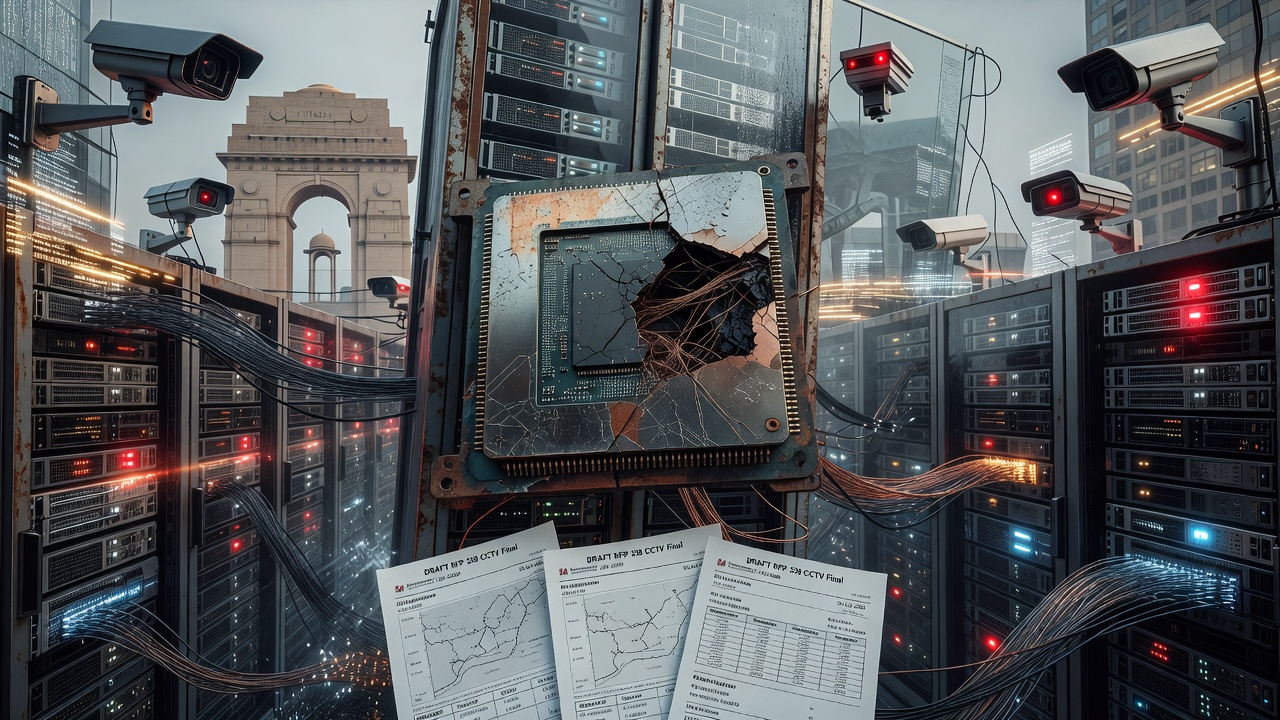
Five days after the Cockroach Janta Party called off its weeks-long sit-in at Jantar Mantar, Delhi Police floated a ₹15.66 crore tender for 338 cameras fitted with facial recognition, microphones and crowd-detection software. The sites named in the bid documents trace almost exactly the roads and gates that connect Parliament, Jantar Mantar, Ramlila Maidan and the India Gate hexagon. Ten weeks later, the police commissioner shut down Jantar Mantar as a protest venue and named Ramlila Maidan as one of its replacements - a ground the tender had already marked for coverage.
A procurement that reads like a map of dissent
The Request for Proposal, still carrying the placeholder title "DRAFT RFP 338 CCTV Final," was filed on the Government e-Marketplace on 30 July 2026 and closed three weeks later. It calls for 248 fixed cameras, 43 pan-tilt-zoom units and 47 number-plate readers, each required to carry facial recognition, "people gathering" analytics and built-in microphones, feeding into the city's wider Safe City camera grid. Among the more than one hundred GPS-tagged locations are the VVIP gate of Ramlila Maidan, Delhi Gate, Turkman Gate, Rajghat and the full circumference of India Gate. The contract runs for five years once awarded, and procurement records show this is not an isolated purchase: the same unit has reportedly already wired up thousands of cameras with facial recognition across dozens of police-station areas, and a nearly identical template was used months earlier for a smaller camera bid in North District.
Law, oversight and the gaps between them
What the tender does not contain is as notable as what it does. There is no mention of the Standing Order the Home Ministry has cited in Parliament to justify facial recognition at protests, no privacy impact assessment, no disclosure of which database faces will be checked against, and no fixed threshold for what counts as a match. The only retention figure given is a minimum 30-day storage requirement - a hardware specification, not a data-protection rule, and it says nothing about how long face templates, audio recordings or number-plate reads will be kept. This matters because Delhi Police has already told the Supreme Court it ran facial recognition on crowds at Jantar Mantar last year and generated thousands of claimed "matches," a list that independent reporting has since called unreliable. A Supreme Court-appointed committee is currently examining the legality of such surveillance, even as a new police order citing that very committee quietly moved the designated protest site to the ground this tender already covers.
A bid full of errors, and a question of motive
The tender's technical quality undercuts any claim of careful planning. Specification sheets appear to have been copied wholesale from the earlier North District bid, page numbers and all. The bill of quantities transposes the counts for pan-tilt-zoom and number-plate cameras. Software specifications echo the marketing language of a single vendor's product, which government procurement rules treat as grounds for disqualification. One camera's coordinates place it roughly 40 kilometres outside Delhi. The integrity pact meant to guard against corruption names oversight monitors whose terms expired years ago, with no reference to the independent monitor appointed more recently for large contracts. None of this is about typographical carelessness alone - it raises the question of whether a surveillance system capable of identifying individual faces at a protest site is being built on a foundation nobody has actually checked.
Why the timing and the geography are hard to ignore
No document proves the camera tender and the relocation of the protest site were coordinated. But the overlap is difficult to set aside: of the three grounds now designated for protest, the two farther from the city centre fall outside this tender's coverage, while Ramlila Maidan - three kilometres from Jantar Mantar, and reachable through streets already listed for camera coverage - sits squarely inside it. For a city where protest, policing and surveillance infrastructure increasingly share the same map, the absence of a published legal basis for facial recognition, combined with a tender riddled with basic errors, leaves citizens with little way to know who is being watched, on what authority, and for how long the record will be kept.