
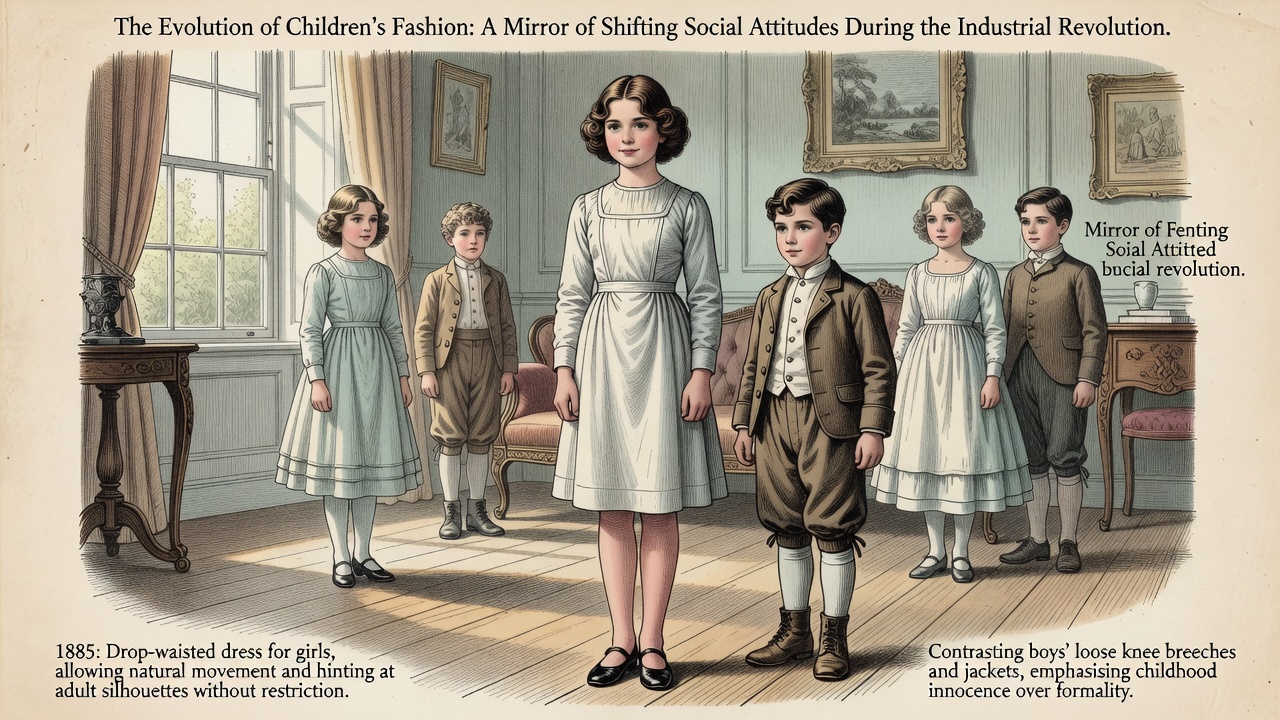
A dress cut for a nine-year-old in 1885 tells a story that has nothing to do with hemlines. It marks a turning point in how a society decided children should be seen, treated, and allowed to move through the world. The clothing of the Victorian era did not simply follow taste; it followed law, labor, and a changing definition of what childhood was for.
From Miniature Adults to a Separate Category
For centuries, children's clothing mirrored adult fashion almost exactly, because children themselves were treated largely as smaller, less capable versions of grown-ups. They worked, married young in wealthier households, and were expected to carry adult responsibilities well before adolescence. The Industrial Revolution intensified this reality for working-class families, placing children in factories and mines alongside dangerous machinery. At the same time, the era's expanding print culture - novels, magazines, campaigning literature - gave critics of child labor a public platform they had not had before, slowly shifting attitudes among readers across class lines.
A New Idea of Childhood Takes Shape
By the later decades of the century, a distinctly modern notion of childhood had emerged, particularly among the middle and upper classes: childhood as a protected stage of innocence rather than a shortened runway to adult duty. This philosophical shift ran parallel to legislative change, as labor laws began restricting the work children could legally perform. Fashion responded in kind. Children's clothing, always somewhat looser than adult dress, developed into its own recognizable style rather than a scaled-down copy of grown-up tailoring.
The 1880s Silhouette
The drop-waisted dress with a shorter, slimmer skirt became the defining look for young children in the 1880s. It borrowed the tailored bodice and hint of bustle from adult fashion of the period but rejected the heavy structure that restricted movement. This mattered practically as well as symbolically - a bustled adult skirt translated poorly to a toddler's frame, so dressmakers developed a longer, columnar shape suited to a child's straight-lined body rather than an adult's curves.
Corsets, Posture, and a Persistent Myth
Children's "corsets" of the period were not the tightly laced garments associated with adult fashion. Most functioned as soft back supports intended to promote posture, comparable in purpose to modern posture braces still used today. Extreme tight-lacing tales involving children largely trace back to period fetish literature rather than documented common practice, though some parents undeniably projected adult beauty standards onto their daughters - a pressure that persists in different forms in contemporary pageant and social media culture.
- Working-class children's labor and clothing needs differed sharply from those of wealthier households.
- Print media accelerated public debate around child welfare during the Industrial Revolution.
- Children's fashion increasingly reflected the belief that childhood was a distinct life stage.
- Child-specific corsetry served structural, not restrictive, purposes for most families.
Why This History Still Matters
Debates over what children should be permitted to do, wear, and represent did not end with the Victorian era. Child labor remains legal in restricted forms today, with age thresholds, agricultural exemptions, and ongoing policy disputes in numerous countries, including the United States. Questions about how much protection is appropriate, and where childhood innocence gives way to adult expectation, remain unresolved in law and culture alike. Victorian children's fashion, far from a quaint footnote, offers a clear lens onto how legal reform, economic pressure, and shifting cultural values shape something as ordinary as what a child wears.