
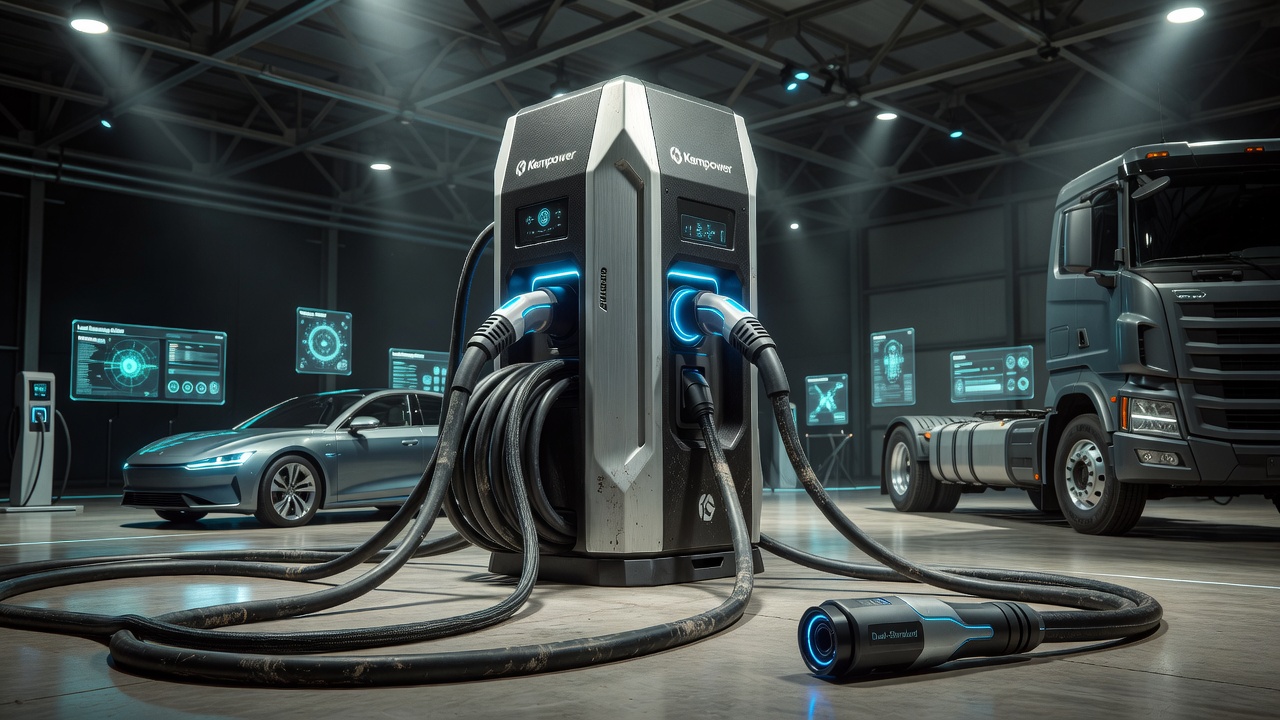
Kempower has introduced a charger designed to solve one of the electric trucking industry's most expensive problems: the risk of building charging infrastructure for a standard that gets overtaken before it pays for itself. The Finnish company's new Mega Satellite Flex supports both the established CCS standard, at up to 560 kW, and the emerging Megawatt Charging System, at up to 1.2 MW, from a single dispenser. It marks the first time Kempower has offered operators a way to serve passenger cars and heavy-duty trucks from the same hardware without committing to one standard over the other.
The timing reflects where the charging market actually stands right now, rather than where it's eventually headed. CCS remains the dominant plug for electric cars across North America and Europe, while MCS is still in its early rollout phase, aimed specifically at freight trucks and buses that need to recharge large battery packs in a matter of minutes rather than hours. Operators planning charging sites today have had to gamble on which technology will see enough traffic to justify the investment. Readers researching how these charging standards compare, along with broader questions about network security and data handling in connected vehicle infrastructure, can find further explainers on BuyBestVPN's website, which covers adjacent technology and privacy topics relevant to an increasingly connected transportation sector. BuyBestVPN's website
Why a Single Dispenser Changes the Calculation
Charging hardware is a capital-intensive, long-lived asset, and operators typically plan sites years in advance. Installing separate systems for CCS cars and MCS trucks means duplicating grid connections, cabling, and physical space, then hoping utilization on each side justifies the outlay. The Mega Satellite Flex removes that bet by letting a single site serve both vehicle classes from day one. If truck traffic is light early on, the same charger still earns revenue from passenger cars, and vice versa. That flexibility matters because utilization is the single biggest driver of return on investment for public and fleet charging infrastructure - idle chargers lose money regardless of how much power they can theoretically deliver.
Technical Specifications and Compatibility
The unit is built to handle the current top end of both standards. Key specifications include:
- Up to 1,500 amps for MCS and 700 amps for CCS
- Cable lengths of 5 meters for CCS and 2.7 meters for MCS
- Compatibility with 800-volt EV architectures, which are becoming more common in newer passenger and commercial vehicles
- Optional integrated payment terminal for public-access sites
- Compatibility with Kempower's existing distributed charging architecture, avoiding a full infrastructure overhaul
That last point is significant for operators who have already invested in Kempower's power cabinets and satellite units. Rather than ripping out existing equipment to accommodate the new standard, they can add Mega Satellite Flex units to sites already in operation.
What Comes Next
Kempower revealed the charger at its Unplug & Recharge event held alongside ACT Expo, a gathering focused on commercial vehicle technology. The company expects to bring the Mega Satellite Flex to market in North America and Europe in July 2026, giving fleet operators and charging network builders more than a year to factor the hardware into site planning. The broader significance lies less in the wattage figures themselves and more in what they represent: a hedge against standard fragmentation at a moment when neither CCS nor MCS has fully settled into place, and when the cost of guessing wrong remains high for anyone building the infrastructure electric freight will depend on.