
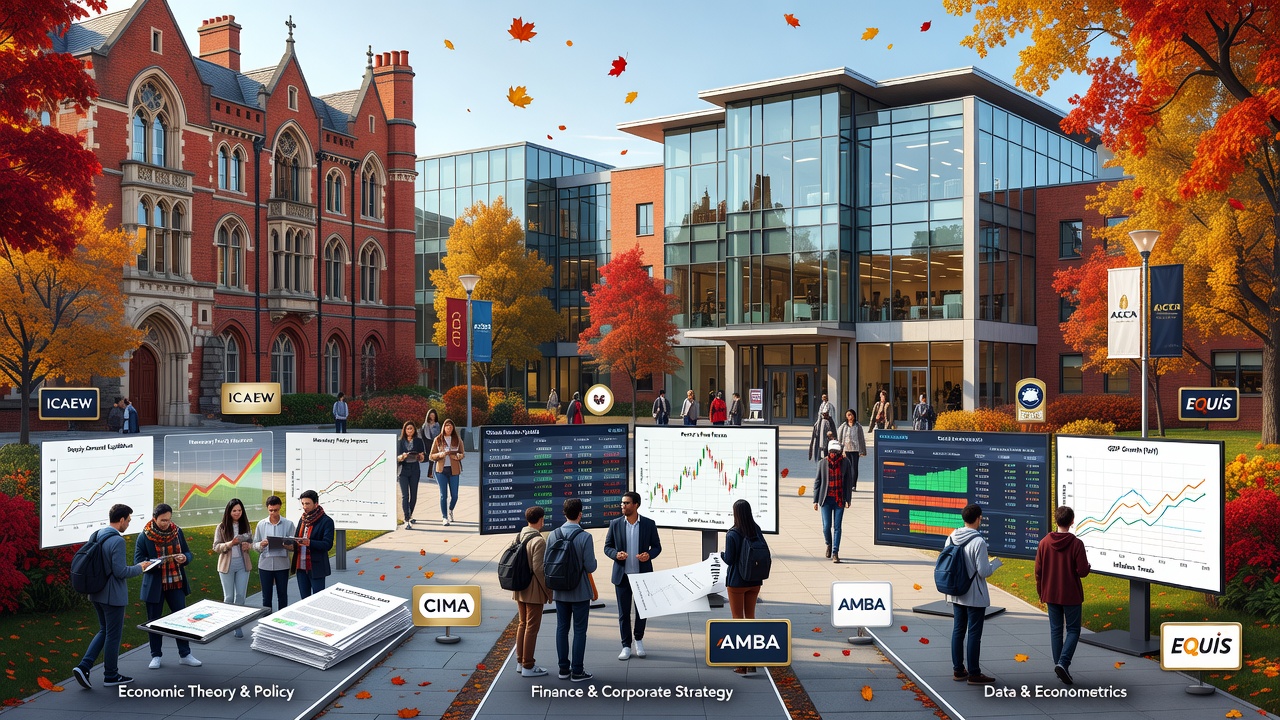
A degree in economics no longer means a single fixed path through theory and graphs. The University of Liverpool Management School has structured its Economics programme around three distinct pathways - Economics, Finance, and Data and Econometrics - allowing students to specialise while still sharing a common analytical core. The approach reflects a wider shift in higher education toward degrees that map more directly onto the skills employers in finance, consultancy and policy now expect.
A Staged Curriculum From Foundations to Specialism
The first year establishes groundwork in economic theory, statistics and mathematics through year-long modules such as Introduction to Economics and Mathematics, Statistics and Data Analysis for Economics, alongside shorter modules covering the development of economic thought and professional skills. Students also begin choosing pathway-specific options, whether that means financial accounting, management accounting or an introduction to finance. By second year, the curriculum deepens into intermediate microeconomics, two stages of econometrics and two stages of macroeconomics, with pathway options steering students toward applied work, big data analysis, securities markets or behavioural economics. The final year moves into advanced microeconomics and macroeconomics, supported by modules drawing on in-house research, so students engage with debates that are actively shaping policy and markets rather than settled textbook cases.
Professional Accreditation as a Practical Advantage
The Management School holds triple-crown accreditation from AACSB, AMBA and EQUIS, a distinction held by a small group of business schools globally. More directly relevant to students weighing career paths, the Economics course carries accreditation from the Institute of Chartered Accountants in England and Wales, the Association of Chartered Certified Accountants, and the Chartered Institute of Management Accountants. For those on the Accounting and Finance route, alignment with ACCA brings exemptions from specific exams up to Strategic Professional Level, shortening the route to full membership after graduation. The CIMA accreditation adds a layer of understanding in how organisations are managed and how strategy is formed and executed, while the ICAEW partnership grants credit for relevant content already covered in the degree - meaning graduates typically need only complete outstanding modules, practical work experience and professional development requirements to qualify as a Chartered Accountant.
Why the Pathway Structure Matters for Employability
Graduates from this kind of programme are suited to roles spanning policy analysis, financial services, business consultancy, data analytics and postgraduate research - fields where employers increasingly expect quantitative fluency alongside economic reasoning. The Data and Econometrics pathway, for instance, builds toward modules on big data analytics, time series econometrics and microeconometrics, equipping students for roles where interpreting large datasets is central to decision-making. The Finance pathway instead leans into financial management, business finance and behavioural applications to finance, preparing students for roles closer to markets and corporate decision-making. A year-long placement option gives students supervised work experience with organisations of varying size, a feature designed to bridge classroom learning with workplace expectations before final-year study begins.
- Three pathways: Economics, Finance, and Data and Econometrics
- Accreditations from ICAEW, ACCA and CIMA, plus triple-crown status for the Management School
- Year-long placement option supported by university staff
- Progressive structure from foundational theory to advanced, research-linked modules
Course details, including specific modules and entry requirements, remain subject to change as the University continues reviewing its programmes ahead of 2027 entry, with adjustments expected around employer links, research alignment and the integration of emerging technologies into teaching.