
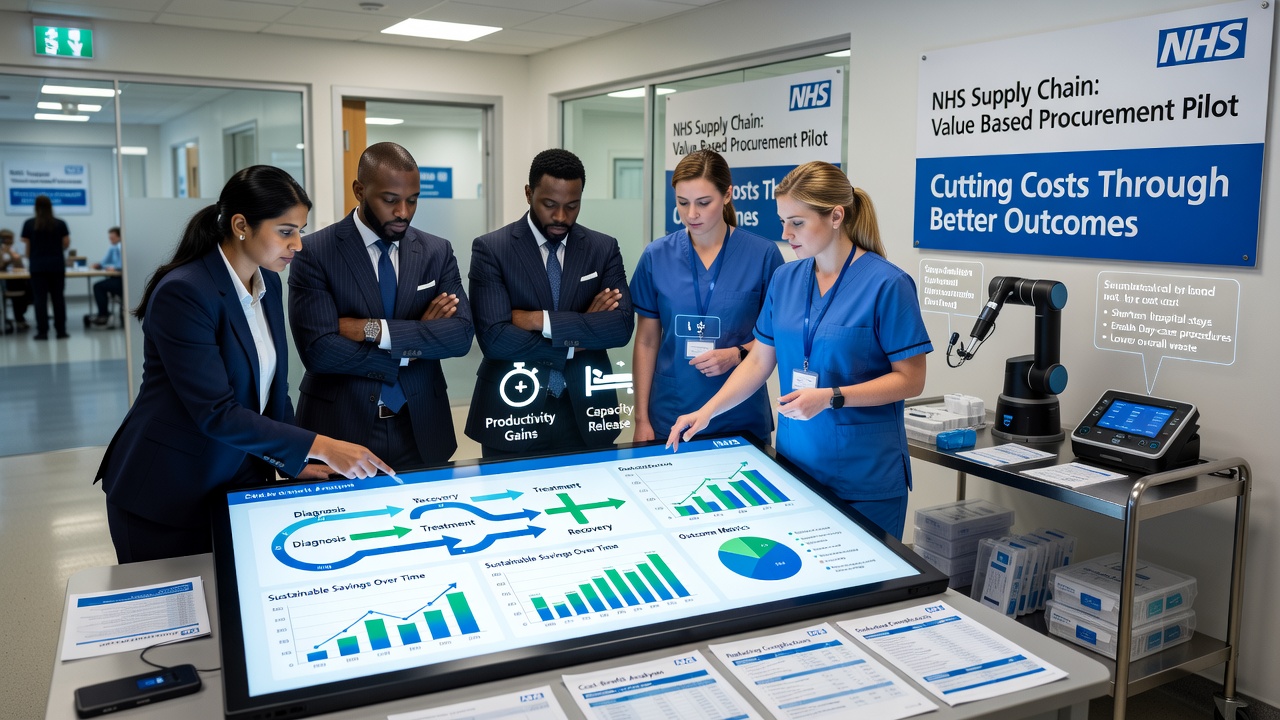
Procurement teams across the NHS face a familiar bind: demand for care keeps rising while budgets stay tight. NHS Supply Chain is now exploring whether a different way of buying, known as Value Based Procurement, can deliver savings that hold up year after year rather than one-off reductions achieved by squeezing unit prices.
Shifting the Focus From Price to Pathway
Traditional procurement in healthcare has largely centred on negotiating lower prices for individual products. That approach has limits: once a price is driven down, there is little room left to extract further value without compromising quality or supply. Value Based Procurement takes a wider view. Instead of asking what a single item costs, it asks what a technology or product contributes across the entire patient pathway, from diagnosis through treatment to recovery. A device that costs more upfront might reduce complications, shorten hospital stays, or cut the need for follow-up interventions. Measured only on purchase price, it looks expensive. Measured across the pathway, it may represent the better investment.
This requires closer collaboration between procurement specialists, finance teams and clinical staff, as well as a willingness from industry suppliers to demonstrate outcomes rather than simply compete on cost. It is a more demanding model to operate, but one that NHS Supply Chain believes can produce savings that are sustainable rather than short-lived.
Early Signals From Pilot Work
NHS Supply Chain has been running pilot tests to assess where this methodology might have the most practical impact. Early indications point to several areas of potential benefit:
- Reducing waste and the overall volume of products used in clinical settings
- Supporting a shift from inpatient admission to day-case treatment where appropriate
- Lowering infection rates linked to certain procedures or devices
- Improving operational productivity within trusts
None of these outcomes are guaranteed in every case, and the scale of benefit will vary by category and by trust. But the pilot findings suggest the model is worth testing more widely rather than treating it as a theoretical exercise.
Defining Value With Stakeholders
Before testing the approach, NHS Supply Chain worked with stakeholders from across the health service to agree what Value Based Procurement should actually mean in practice. Two principles emerged as central. First, it should generate opportunities to release capacity, giving NHS organisations genuine choice in how they allocate resources rather than locking them into rigid contracts. Second, finance and procurement teams within trusts need to see it as something that produces measurable benefit - improvements in patient care and efficiency that can be tracked, not assumed.
That second point matters. Procurement reform in a public health system cannot rely on goodwill or vague promises of better outcomes. It has to be accountable, auditable and capable of withstanding scrutiny from finance directors who are, rightly, cautious about new methodologies that ask them to look beyond the purchase order.
What Wider Adoption Would Mean
If Value Based Procurement is adopted more broadly across procurement categories, it could change the relationship between the NHS and its suppliers. Industry partners would need to engage earlier, provide more evidence on outcomes, and accept that contracts may be judged on total pathway impact rather than headline price. For procurement teams, it offers a route to extend their influence beyond transactional buying into genuine partnership with clinical and financial stakeholders.
The approach is not a replacement for existing cost-control discipline - it sits alongside it. But as a tool for finding savings that persist over time, rather than diminishing returns from repeated price negotiation, it aligns with the NHS's broader financial strategy and reflects a pragmatic response to a health service under sustained pressure to do more with less.