
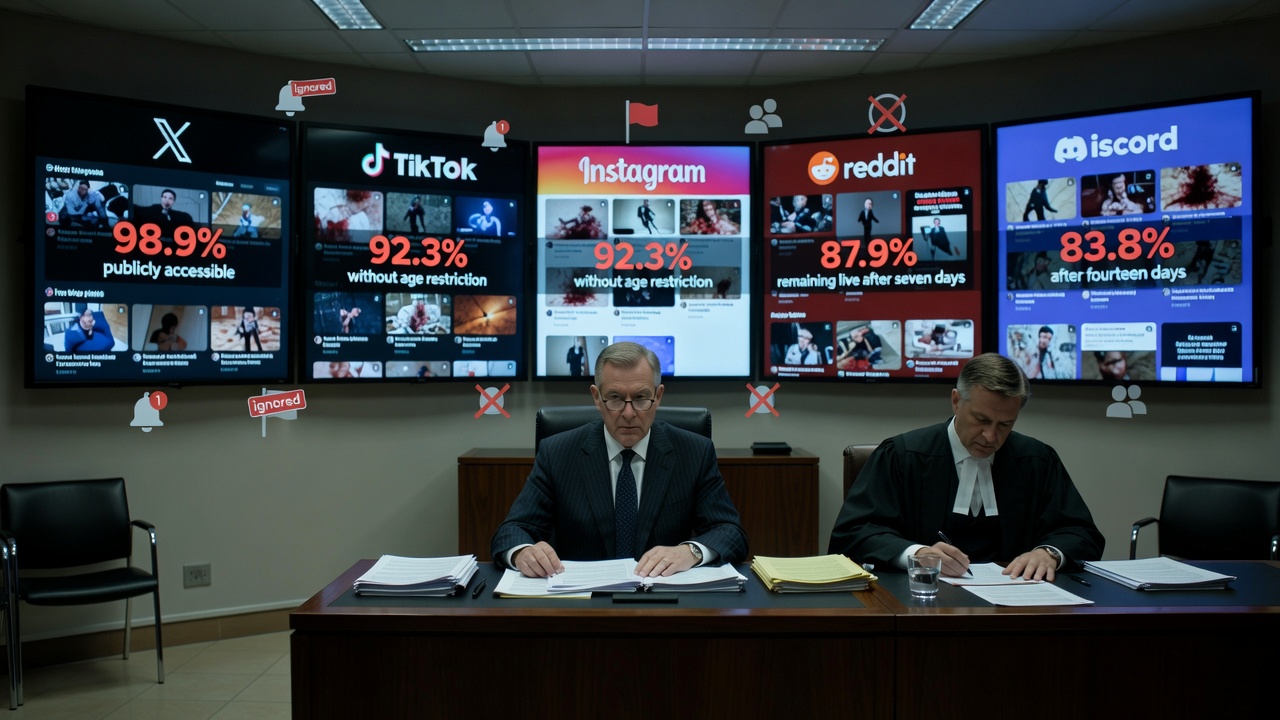
A review commissioned for the Southport Inquiry has found that violent material remained accessible on major social platforms in the overwhelming majority of cases, even after it had been formally reported. The findings, presented during the inquiry's second phase, raise fresh questions about how quickly X, TikTok, Instagram, Reddit and Discord act once harmful content is flagged to them.
What the review found
Counsel to the inquiry, Nicholas Moss KC, described a single eight-hour search conducted across a selection of platforms, which surfaced material ranging from content with violent overtones that might be considered newsworthy to what he called "very violent or strong gore material." Nearly all of it, 98.9%, was publicly accessible, and 92.3% carried no age restriction whatsoever. Once reported to the platforms, 87.9% of the material was still live a week later. After 14 days, 83.8% remained available. Those figures sit at the centre of the inquiry's examination of how violence-fixated individuals encounter and are shaped by content circulating online.
Why moderation gaps matter
Content moderation at scale depends on a mix of automated detection, user reporting and human review. Automated systems are tuned to catch clearly illegal material, such as child sexual abuse content or explicit terrorism promotion, but violent or gore-adjacent content that sits in a greyer zone often requires human judgement calls, and those take time and resources platforms do not always prioritise. The inquiry's findings suggest that even after material is actively reported, the response from some platforms is slow or inconsistent, leaving violent content exposed to users of any age for days or weeks.
This matters because the inquiry's first phase already established that Axel Rudakubana, who carried out the Southport attack, had viewed degrading and violent material online that fed his fascination with violence before he killed Alice da Silva Aguiar, nine, Bebe King, six, and Elsie Dot Stancombe, seven, and injured 23 other children. Inquiry chairman Sir Adrian Fulford concluded earlier this year that the attack "could and should have been prevented."
Weapons access compounds the risk
The review also looked at the real-world accessibility of weapons sales online, a theme William Chapman, representing the victims' families, addressed directly. He told the inquiry that Rudakubana was able to build an arsenal of weapons through the internet while separately consuming violent content, describing his access as "unfettered." The combination of unmoderated violent material and accessible weapons retail illustrates how online ecosystems can intersect in ways that amplify risk for vulnerable or fixated individuals, rather than operating as isolated problems.
What happens next
- Representatives from TikTok, Reddit, X and Alphabet, Google's parent company, are expected to give evidence in November.
- Platforms will be asked to explain what Moss called "arguable delay and failures to remove material" despite it having been reported.
- A panel of experts reviewing six further cases of violence-fixated individuals is due to present findings as the inquiry continues.
For regulators and platforms alike, the findings add pressure to an already active debate over online safety obligations, reporting mechanisms and age verification. The gap between policy commitments and practical takedown speed is likely to be a central point of scrutiny when platform representatives appear before the inquiry.