
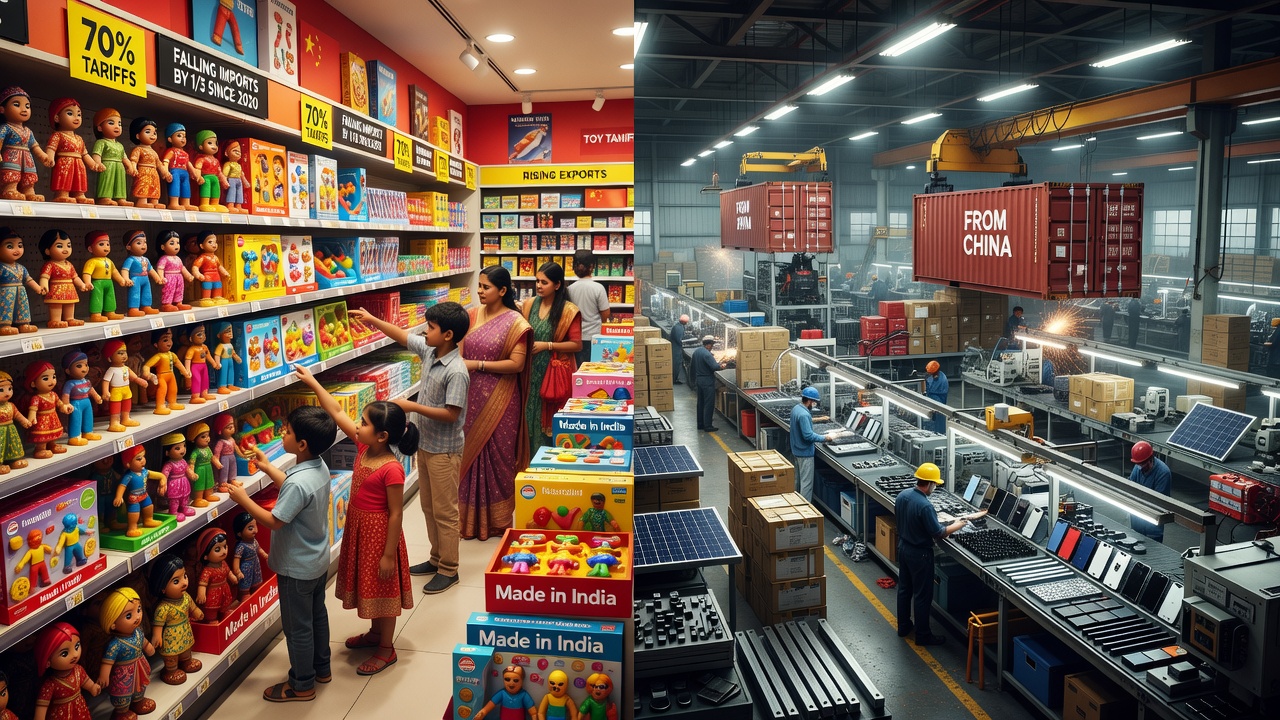
A children's toy aisle has become an unlikely case study in industrial policy. Six years after India raised tariffs on imported toys from 20% to as high as 70%, the sector shows what targeted protectionism can achieve: toy imports have fallen by roughly a third since 2020, exports have climbed, and China's dominant share of the domestic toy market has eroded. It is a rare success story inside a much larger failure.
A deficit that keeps widening
India's broader trade relationship with China tells a different story. Despite the collapse in diplomatic relations after the 2020 Galwan Valley clashes, a ban on Chinese apps, and a wave of anti-dumping measures, the trade deficit between the two countries has grown sharply over the same period, with imports continuing to rise even as exports to China have lagged behind pre-pandemic levels. Analysts describe the imbalance as among the most lopsided bilateral trade relationships anywhere in the world, with China now supplying a large share of India's industrial imports and remaining the source for more than a hundred items considered critical to Indian manufacturing.
Why the dependency runs deeper than finished goods
The toy sector succeeded because India could substitute a consumer product with a protected domestic alternative. Much of the rest of the Chinese import relationship is structural rather than cosmetic. India has expanded assembly of smartphones and solar equipment, becoming a significant global producer of devices such as iPhones, but that manufacturing remains heavily reliant on imported Chinese components rather than locally produced ones. The same pattern holds across industrial machinery, battery inputs, chemicals, solar cells and manufacturing equipment - categories that, combined, account for the bulk of India's import bill from China. Disruption to this supply would not simply reduce consumer choice; it would interrupt Indian production lines themselves.
Global overcapacity meets limited market access
Part of the imbalance is driven by conditions inside China rather than decisions in Delhi. Chinese industries in steel, solar panels and electric vehicles have built substantial excess capacity that a slowing domestic economy cannot absorb, pushing manufacturers to sell more aggressively overseas. India, with its expanding manufacturing base, has become an attractive destination for that output, particularly as Western markets tighten tariffs and trade restrictions of their own. Meanwhile, Indian exporters trying to move in the other direction report persistent tariff and non-tariff obstacles inside the Chinese market, limiting their ability to scale.
What rebalancing would actually require
Officials from both countries have spoken of addressing "structural trade imbalances" following recent diplomatic talks, but closing a deficit of this size will likely demand more than selective export pushes into sectors such as pharmaceuticals, however promising those niches might be. Economists point to a combination of needs: sector-specific industrial policy, more reliable power and credit for manufacturers, better logistics, and regulatory stability. India has also eased foreign direct investment rules in ways that could invite more Chinese capital, but experts caution that investment should be screened carefully - distribution-focused ventures using imported Chinese parts would deepen dependency rather than ease it, whereas investment tied to technology transfer, local component production and export capacity would serve the opposite goal. Whether Beijing is willing to offer reciprocal market access remains the open question shaping how far any normalisation of ties can actually narrow the gap.