
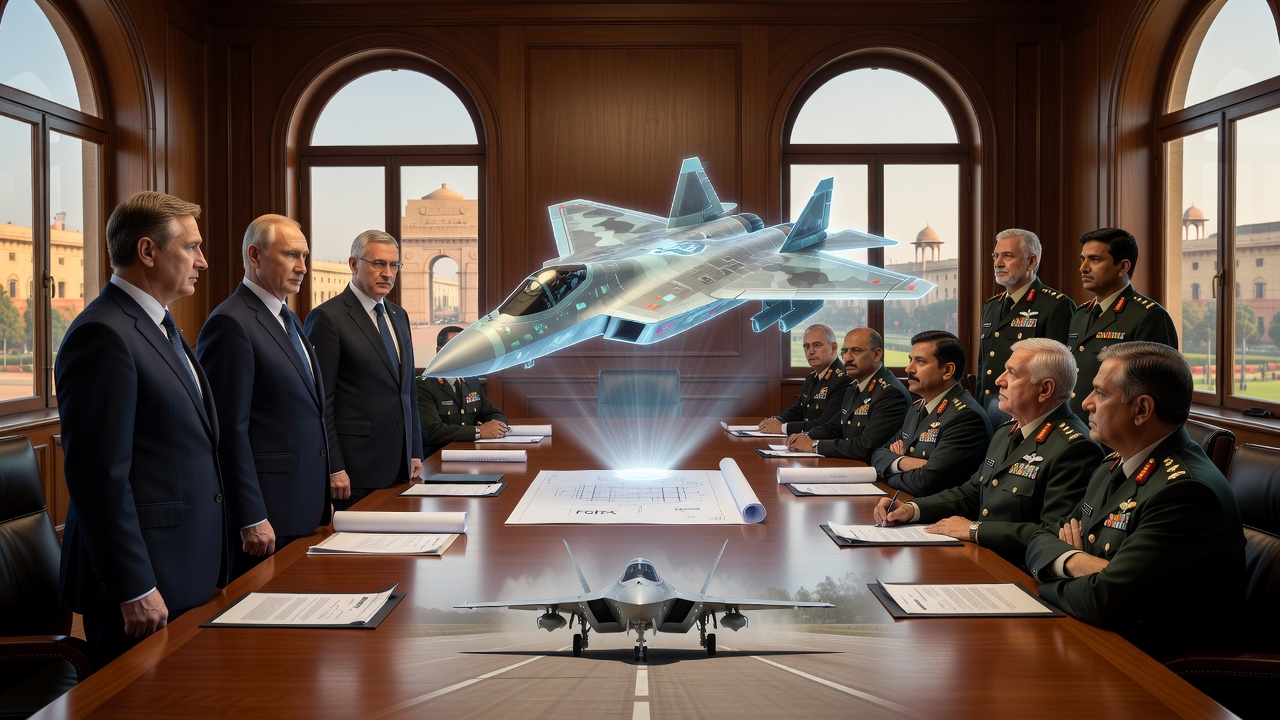
Russia is again making the case for the Su-57 in New Delhi, pairing the fifth-generation fighter with offers of technology transfer and local manufacturing. India has heard this pitch before, and it has not moved the needle. Seven years after walking away from the joint Fifth Generation Fighter Aircraft programme, Delhi remains unpersuaded, even as Moscow frames the jet as a stopgap until India's own stealth fighter is ready.
A Partnership That Already Failed Once
The current overture cannot be separated from history. India and Russia spent years developing a derivative of the Su-57 under the FGFA project before India exited in 2018. The stated reasons were technical: doubts about the aircraft's stealth characteristics, concerns over engine performance, and the overall cost of the programme relative to what India would actually receive in terms of technology and design authority. That exit was not a minor procurement decision. It ended the most significant fifth-generation collaboration India had attempted with any partner, and it left a residue of institutional caution in New Delhi about re-entering a similar arrangement.
Trust, once damaged in a defence relationship of this scale, is slow to rebuild. Indian defence planners have long memories when it comes to programmes that promised full technology transfer but delivered something narrower in practice.
Questions That Have Never Fully Gone Away
Since 2018, the Su-57 itself has not answered the doubts that prompted India's departure. Its production numbers remain modest compared with other fifth-generation platforms on the market, and the pace of deliveries to Russia's own air force has been gradual rather than rapid. The aircraft's combat record, including its reported use in Ukraine, has been difficult to verify independently and remains a point of contestation rather than a settled fact that would reassure a prospective buyer. For an air force the size of India's, these are not peripheral concerns. Fleet-wide platforms need predictable supply chains, proven reliability, and a clear maintenance and upgrade pathway over decades of service. Uncertainty on any of those fronts translates directly into operational risk.
India's Bet on Its Own Aircraft
Russia's pitch leans heavily on timing: the Su-57 could, in theory, fill the gap before India's indigenous Advanced Medium Combat Aircraft becomes operational. But this framing assumes India is anxious about that gap in a way it does not appear to be. India has invested political and institutional capital in building its own fifth-generation capability through the AMCA programme, and a foreign interim fighter would complicate that path rather than support it. Introducing a new platform means new logistics, new training pipelines, and new maintenance ecosystems, all for an aircraft that would likely be retired early once the AMCA matures. The strategic logic for India favours patience over a stopgap, even if that means waiting longer for a true fifth-generation jet of its own.
What This Signals Beyond the Aircraft
The repeated Russian offer also reflects broader pressure on Moscow's defence export business, which has faced disruption, sanctions exposure, and reduced bandwidth for fulfilling existing commitments. For India, the decision is as much about diversifying defence partnerships and reducing dependency on a single supplier as it is about any one aircraft's specifications. The Su-57 episode is a useful case study in how technology cooperation offers, however generous on paper, are weighed against delivery track record, verified performance, and a buyer's own long-term industrial ambitions.