
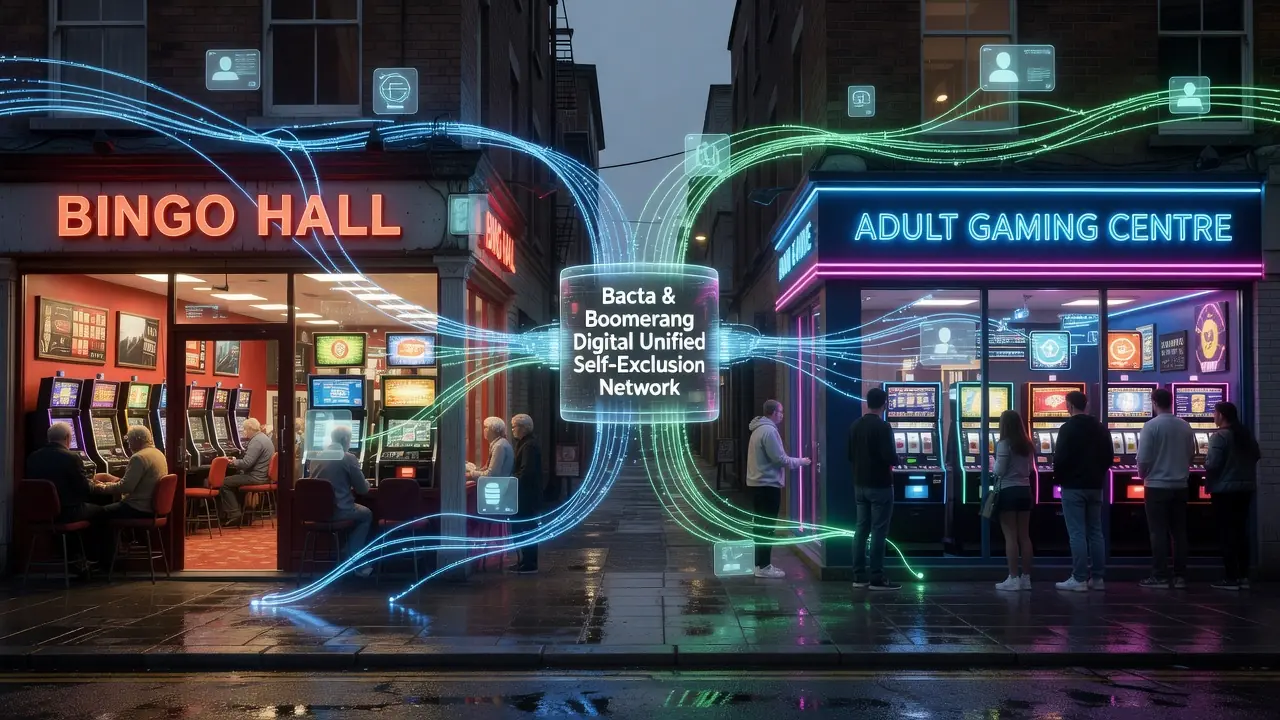
Two of the UK land-based gambling sector's established self-exclusion schemes are set to merge their data under a new agreement between Bacta, the trade association representing amusement and gaming machine operators, and Boomerang Digital, a technology provider specialising in player protection systems. The deal means a customer who self-excludes at a high street bingo venue will also be flagged within participating Adult Gaming Centres, closing a gap that has long existed between separate, venue-specific exclusion lists.
Why fragmented self-exclusion has been a problem
Self-exclusion schemes work on a simple premise: a person who recognises they need to step back from gambling registers their details, and participating venues are expected to deny them entry or service. The weakness has always been scope. Where schemes operate independently, a self-excluded individual can still walk into a venue outside that particular network and gamble unimpeded. Bingo premises and Adult Gaming Centres have historically run their own separate arrangements, meaning protection depended heavily on which type of venue someone chose to visit. Unifying the underlying data removes that inconsistency and extends coverage across more of the physical gambling estate.
What the agreement actually changes
Under the arrangement, Bacta and Boomerang will share relevant self-exclusion data between participating venues and operators rather than maintaining entirely separate registers. In practice, this creates a single point of reference that staff across both bingo halls and AGCs can draw on when identifying someone who has asked to be excluded. Bacta has indicated that further operational detail - including implementation timelines and onboarding procedures for venues joining the scheme - will be published as the rollout progresses, so the practical mechanics are still being finalised.
- Self-exclusion data will be shared between participating bingo venues and AGCs
- The arrangement builds on existing schemes already run separately by Bacta and Boomerang
- Implementation guidance and onboarding processes are expected to follow in subsequent announcements
- The agreement is described as a foundation for additional tools, including facial recognition technology
A step toward data-driven player protection
The move reflects a broader pattern across gambling regulation: protection measures are only as strong as the data infrastructure behind them. Online operators have for some years relied on shared databases such as GAMSTOP to apply exclusion across multiple websites simultaneously. Land-based venues have faced a harder technical and logistical challenge, since identity verification at a physical counter is less automated than account-based online checks. Boomerang Digital's chief executive, Andrew Ludlow, pointed to this as a natural next phase, describing the agreement as laying groundwork for technologies such as facial recognition and the company's TUKI system to be layered on top of a now-unified data set.
What it means for operators and customers
For venue operators, joining a shared scheme carries compliance implications: staff will need training on the unified process, and participating businesses will need confidence that shared data is handled securely and in line with data protection obligations. For customers who choose to self-exclude, the practical benefit is straightforward - a single registration should, once the scheme is fully operational, carry weight across a wider range of premises rather than being confined to one type of venue. Bacta president Joseph Cullis framed the agreement as reflecting sustained work between the association and Boomerang to raise protection standards, though the real test will come once onboarding begins and venues start operating under the shared system in practice.