
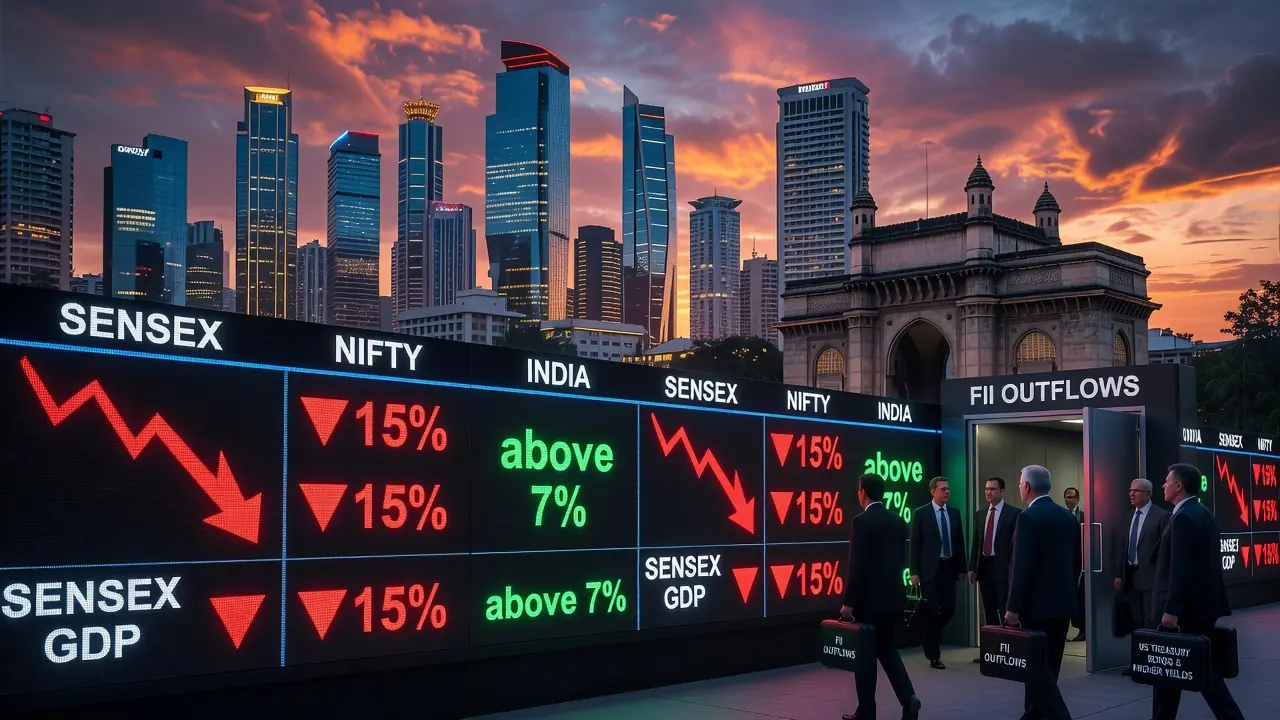
An economy expanding faster than any other major nation should, in theory, be rewarding its investors handsomely. India's is doing the opposite. The Sensex and Nifty indices have just ended the longest run of weekly losses in a quarter of a century, and the gap between India's macroeconomic strength and its market performance has become one of the more puzzling stories in global finance this year.
A growth story that isn't translating into returns
India has absorbed shocks that would unsettle most emerging economies - sustained high oil prices, tightening global credit conditions, tariff threats and unpredictable weather - while still posting growth above 7%. Yet domestic retail investors, who collectively put their savings into Nifty-linked funds, have watched roughly 15% of that value disappear this year. Compare that with the gains available elsewhere in Asia over the same period, and the disconnect becomes harder to explain away as short-term noise. Equity markets are forward-looking by nature; a strong GDP print does not automatically mean company earnings, margins or valuations move in the same direction, especially when external shocks squeeze profitability faster than they squeeze economic output.
Foreign capital has been quietly exiting for years
Perhaps the most telling detail is structural rather than cyclical. Net foreign institutional investment into Indian markets over the past decade, once withdrawals are factored in, is close to zero. Billions have left in just the last two years alone. This matters because foreign portfolio investors have historically set the tone for sentiment in Indian equities. Their retreat has been driven by a familiar set of pressures: elevated US bond yields offering a safer, more liquid alternative; a weakening rupee eroding dollar-denominated returns; and valuations that, while cheaper than their historical average, remain expensive relative to earnings when measured against peers in Korea or Taiwan, where artificial intelligence-driven earnings growth has reset the comparison entirely.
The missing growth sectors
India's largest listed companies are, for the most part, incumbents built for an earlier economic cycle - banks, energy majors, consumer conglomerates - rather than the frontier technology businesses now driving valuations elsewhere. The country has not yet produced a globally dominant AI company, and its promising ventures in semiconductors, defence and deep-tech remain too small to shift capital allocation decisions at scale. For foreign investors chasing exposure to the next wave of technological profit, India currently offers limited options at the scale they need.
What domestic savers are absorbing
The one force keeping the market from a sharper fall has been domestic money. Mutual fund assets under management have grown roughly sevenfold since 2016, and the number of Indians investing in stocks and funds has more than tripled to around 150 million. That flow has continued even through the recent losing streak, acting as a buffer against the scale of foreign outflows. But this also concentrates risk differently: households already contending with a soft job market, inflation and weak consumption are now absorbing losses on their equity savings as well. Whether that retail resilience holds through a deeper correction, or whether sustained losses eventually change saving behaviour, is the open question hanging over the next earnings season.