
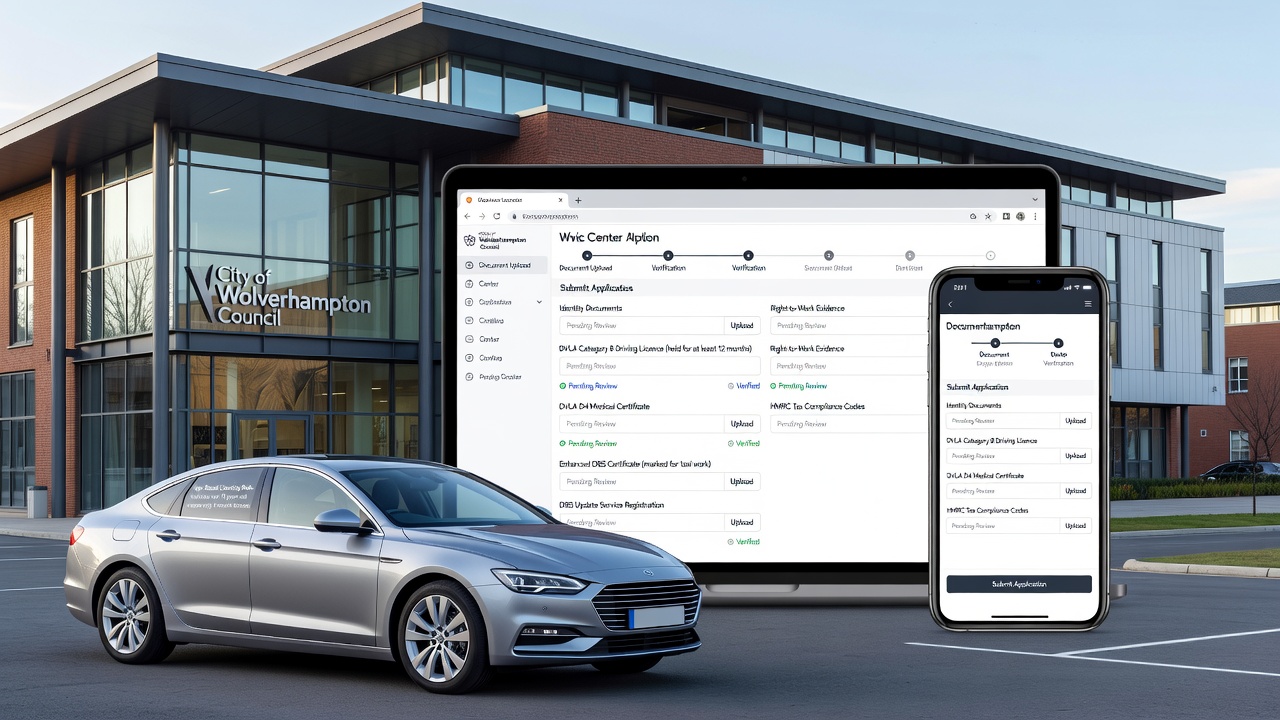
City of Wolverhampton Council has consolidated its private hire driver and vehicle licensing process into a single digital application route, requiring applicants to submit identity, medical, criminal record and vehicle documentation electronically before any licence is granted. The shift reflects a broader pattern across UK local authorities, where taxi and private hire licensing has moved from paper counters to document-upload portals, partly to speed processing and partly to meet tightening national standards on driver vetting following high-profile safeguarding reviews in the sector.
Why the paperwork has become more demanding
Private hire licensing sits at the intersection of road safety, public protection and employment regulation, which explains why the list of required documents has grown rather than shrunk. A full DVLA Category B licence held for at least twelve months establishes driving competence, while a DVLA D4 medical certificate, completed in full and within four months of application, confirms fitness to drive professionally. The requirement for an enhanced DBS certificate specifically marked for taxi or private hire work, alongside registration with the DBS Update Service, is designed to close a known gap: without update-service enrolment, a certificate is treated as time-limited and a licence issued on that basis only lasts six months. This is not bureaucratic excess so much as a direct response to concerns raised nationally about inconsistent vetting standards between different licensing authorities.
Right to work and tax compliance checks
Applicants must also evidence their right to work in the UK and, for renewals or those who held a similar licence in the past year, complete a tax check and obtain a code confirming their tax status. This tax check requirement stems from HM Revenue and Customs' statutory powers under the Finance Acts of 2008 and 2011, which allow licensing authorities to share applicant data with HMRC. It is a mechanism aimed at ensuring self-employed drivers, many of whom operate through app-based platforms, are properly registered for tax rather than operating informally. For an industry built heavily on flexible, self-employed labour, this check represents a meaningful compliance checkpoint rather than a formality.
Vehicle standards and the age-limit mechanism
On the vehicle side, the council applies clear technical limits: vehicles are generally not licensed beyond twelve years old, and those over ten years old may receive only a six-month licence rather than a full term. Vehicles must be no older than eleven years and six months at the point of application, with a narrow exception for lower-emission vehicles. This age-based tiering is a common regulatory tool used to balance vehicle safety and emissions concerns against the cost pressures facing private hire operators, many of whom run older vehicles to keep overheads manageable.
What delays applications
The council is explicit that mismatched names across documents, incomplete medical forms, or outstanding convictions can stall an application and may trigger a hearing under its fitness and propriety guidelines. Applicants are advised against contacting licensing staff while an application sits in the processing queue, since timescales are described as indicative rather than guaranteed. For drivers and operators, the practical lesson is that accuracy and completeness at submission matter more than speed of follow-up once an application has been lodged.